Posts

Showing posts with the label Uganda

AFCON 2027: Uganda, Kenya and Tanzania co-hosting has implications beyond football

Image
On September 27th 2023, the Confederation of African Football President, Patrice Motsepe, announced in Cairo that East Africa's “Pamoja Bid” had been successful . The announcement meant that Uganda, Kenya, and Tanzania would be the joint hosts for the 2027 Africa Cup of Nations (AFCON).  This historic decision marked a transformative moment for East African football and the broader CECAFA region because it had been 47 years since an East African nation – Ethiopia, to be precise – had hosted the continental football tournament.  The 2027 AFCON will not only be the first to be hosted in the CECAFA region since then but it will also be the first edition co-hosted by three distinct nations. The significance of this shared hosting will be felt in many areas. Not only does it provide a platform to enhance regional unity, but it also magnifies the cultures and capabilities of the three original members of the East African Community.  Moreover, the collaborative nature of the e...

Africa Climate Summit: A United Front for Climate Action

Image
Kenyan President William Ruto addresses the media during the Africa Climate Summit. Photo: Presidential Communication Service, Government of Kenya The inaugural Africa Climate Summit , held from 4th to 6th September in Nairobi, concluded with a resounding call to action. World leaders, international organisations, and civil society converged to discuss the continent's unique position in the global fight against climate change. The summit culminated in the Nairobi Declaration, a document that will serve as Africa's negotiating stance at the upcoming COP28 summit . The three-day event, hosted by the Kenyan government and the African Union, saw participation from global figures including UN Secretary-General António Guterres, President of the European Commission Ursula von der Leyen, and African Development Bank President Akinwumi A. Adesina. Their collective message was clear: Africa is central to the global climate solution. Africa's Unique Position Kenya's President Wil...

Advancing Natural Language Processing Research in Africa: Challenges and Progress

Image
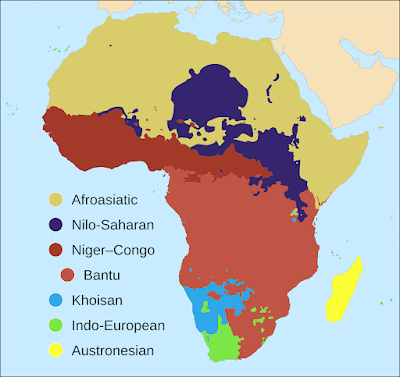
Map of the major language families of Africa (Courtesy: Wikimedia Commons)   Natural language processing (NLP) is a rapidly evolving field, with applications ranging from chatbots to voice recognition systems. However, for a long time, the focus of NLP research has been primarily on widely spoken languages like English, leaving behind the rich linguistic diversity of Africa . There are many challenges faced by researchers in Africa's NLP landscape but there are also some promising initiatives that are working to bridge the gap. The Challenge of Limited Data One of the most significant challenges in African NLP research is the scarcity of training data for African languages . Most available data for NLP models comes from widely spoken languages, such as English, which makes it difficult to develop effective AI tools for African languages. This limited data poses a significant obstacle to progress in this field. Linguistic Diversity Adds Complexity Africa is home to a vast array ...

UCC not doing enough to sensitise the public on digital migration

Image
Kampalans lining up to buy GOTV decoders. What most don't know is that digital migration is not the same as subscribing to a digital PayTV provide r (photo courtesy of Daily Monitor) The confusion surrounding the recent switch-off of some TV stations in and around Kampala as equipment to enable migration to digital television was being installed on the Kololo TV mast exposed just how little sensitisation has been done to prepare the public for digital migration.  The Uganda Communications Commission (UCC) has done a poor job sensitizing Ugandans on the digital migration to the extent that even the few who  have an idea of what digital migration is about associate the move to digital with subscription services like StarTimes and GoTV. UCC has not done enough to sensitize the public on the purchase of free-to-air decoders (for which no subscription is required) and how these will work and it has instead kept quiet while the PayTV stations are raking in millions fr...

Mass indiscriminate Police arrests will ultimately be counter-productive

Image
Mbarara residents recently under police detention whose only crime  is not possessing ID. Photo by Colleb Mugume Courtesy of Monitor Publications. Early in the morning on Wednesday 3rd July 2013 the police in Mbarara municipality conducted a pre-dawn security operation in the municipality’s Kakoba division ostensibly to weed out criminal elements that have been terrorising the area's residents for some time. The event that triggered this operation was, supposedly, the murder of a World Food Programme employee Andrew Mpubani, who was killed outside his home in the area a few days earlier. During the raid the police rounded up hundreds of people and detained as suspects those who could not immediately identify themselves with resident Identity cards. While the police should ordinarily be applauded for vigorously trying to combat crime, one cannot help but think that the Kakoba operation was nothing more than a show for the public and media, which will ultimately prove counter-...

Is Information Technology all its been hyped to be?

Image
These days its hard to open a newspaper, watch TV or traverse the information superhighway without coming across an article or blog post praising IT and what a positive impact it has on business the world over or how information technology is literally capable of solving most of the problems known to man. However, despite the undeniable importance of IT in today’s world, sometimes the role (and importance) of IT seems to be overstated for different reasons and in a number of ways. A graphical representation of the Digital Access Index.  See how poorly Africa is  doing (Source: International Telecommunications Union) The rapid growth of IT and ICT use has led to a digital divide between those who have and those who do not have access to IT facilities and services especially in the poorest parts of the world. While the importance of IT is being discussed, it is worthwhile to realise that in some situations only a small section of the population can access this IT and thus ...

And the Kony 2012 juggernaut rolls on

Image
I spent yesterday trying to write a post on my views on Invisible Children's   KONY 2012 video that has gone viral and garnered millions of views (38,430181 on YouTube as I write this). More specifically, I wanted to write about what I thought was wrong with both the approach of the film-makers and the way people without the slightest clue about the LRA (besides the misinformation gleaned from KONY 2012) were taking up the Stop Kony cause with such fervour. However, Twitter could not let me do that in peace because almost every 5  minutes I received links to articles and blog posts reacting to the Invisible Children campaign. Posts like this one by Michael Wilkerson guest posting at Foreign Policy , and this post by  Ugandan blogger Angelo Izama are just two of the many that are out there echoing my feelings.  There is also this video from Ugandan blogger Rosebell Kagumire As a result I feel what I had to say has ...

The dirty politics of radio ownership in Uganda

After the resignation of Minister for the Presidency, Kabakumba Matsiko, from cabinet over accusations of abuse of office and causing the government financial loss while she was Minister of Information, following the police's discovery that a radio station she owned (Kings FM in Masindi) was using a mast and transmitter that belonged to UBC, I thought that there would be no more stories on stolen masts and other misused UBC equipment. However, this week the media reported that 35 more cabinet ministers were to be probed for abuse of public resources (read using UBC equipment and services without paying) and it is starting to look like Kabakumba’s case might be the rule rather than the exception. Two thoughts came to my mind when I reflected on the media stories: The UBC must have acquiesced to its equipment being used for free (despite the official line saying those using UBC equipment without paying were doing so by colluding with some lowly employees) Are there any op...